
Teachers across India put immense effort into making lessons meaningful. But in a nation as diverse as ours, achieving true inclusive education is a complex challenge. Inclusion is more than just getting students into a classroom; it's about ensuring every child - regardless of their abilities - can participate, express themselves, and succeed.
As classrooms evolve, traditional "one-size-fits-all" teaching methods are losing their effectiveness. To meet the goals of the NEP 2020, schools are turning to digital boards and interactive displays to break down barriers and ensure that every student feels they belong.
The Invisible Gaps in Traditional Classrooms
Traditional teaching is often lecture-based, favoring students who process information best through listening. This creates "invisible gaps" for:
- Neurodiverse learners who may need visual reinforcement.
- Non-verbal students who express knowledge better through touch or drawing.
- Multilingual learners who benefit from real-time translation and visual aids.
Without the right classroom technology, these students may struggle to demonstrate what they know, leading to frustration and lower learning outcomes.
India's Shift Toward Inclusive Education
With the National Education Policy (NEP) 2020, India's educational system is undergoing a dramatic change. The policy demands flexible, learner-centered classrooms where strategies adjust to the student.
Programs like the NIPUN Bharat Mission further emphasize that no child should be left behind, moving the focus from simple access to meaningful participation.
UDL: Inclusion by Design
To put policy into action, many educators use Universal Design for Learning (UDL). This framework encourages teachers to provide multiple ways for students to engage with a lesson.
Instead of adding "extra help" later, UDL makes learning accessible from the start. By using an interactive flat panel, teachers can offer auditory, visual, and kinesthetic paths simultaneously, ensuring that neurodivergent or multilingual learners aren't sidelined by a lecture-only format.
A Living Example: Sense Kaleidoscopes, Bengaluru
Sense Kaleidoscopes in Bengaluru provides a striking illustration of this in practice. Founded by Akshayee, the school recognizes that "growing up unnoticed" causes profound harm.
By using a curriculum tailored for neurodivergent learners - mixing academics with arts and technology - they prove that inclusion is a dynamic practice. It's about creating an environment where students develop at their own speed, supported by classroom technology that amplifies their unique voices.
Scaling Inclusion with SMART Technologies
While individual schools show us what is possible, scaling this across India requires a robust EdTech ecosystem. SMART Technologies provides the tools to make inclusive practices a reality in every classroom.
- Interactive Displays for Schools: Our SMART Board® series allows students to interact with lessons directly. Whether it's a student with limited mobility using a stylus or a visual learner engaging with 4K content, these displays reduce communication barriers.
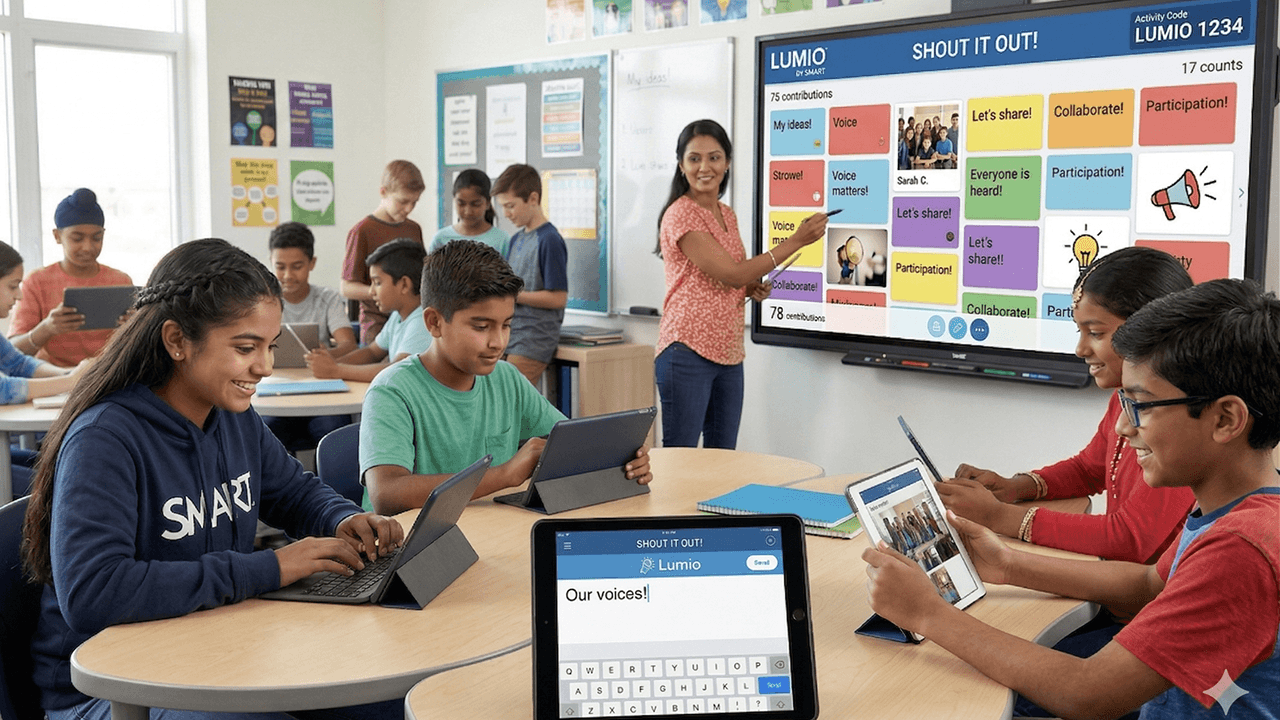
- Lumio by SMART Technologies: This digital learning platform allows teachers to transform static PDFs into interactive games and collaborative workspaces. Students can contribute from their own devices, ensuring that even the quietest learner has a platform to share.
Toward Truly Inclusive Classrooms
Inclusion is a journey, not a destination. When we combine India's visionary policy frameworks with interactive technology, we create spaces where every student is seen and valued.
Ready to see how technology can transform your classroom? Try Lumio for free and start building a more inclusive learning environment today.