Every April, the conversation around autism gets a little louder. Awareness campaigns fill social feeds, schools hang colourful bunting, and well-meaning messages about "acceptance" circulate widely.
While awareness matters (it genuinely does) I've been thinking a lot lately about what comes after awareness. Because awareness, on its own, doesn't change much for the autistic student who's spending their days masking in a classroom environment that was never really designed with them in mind.
Over the past two years, I've had the privilege of being part of something that I think points toward a better answer.
The University of Melbourne partnered with SMART Technologies to explore how digital technologies, guided by Universal Design for Learning (UDL) principles, could meaningfully support neurodivergent learners. What made this research different was a deliberate choice to do something that educational research has historically failed to do: ask the students what works for them.
When our team reviewed the existing literature on supporting neurodivergent learners at school, a pattern emerged. Autistic learners' perspectives were less frequently sought compared to other diagnostic groups.
The research often spoke about autistic students rather than with them.
Associate Professor Matt Harrison, Dr. Emily H. White, Melissa Vallence, Dr. Nikita Potemkin, and I — all of us with our own lived experiences of neurodivergence — set out to address that gap directly. Through classroom observations and in-depth interviews with staff and students across six case study schools, we developed 36 recommendations for the effective use of digital technologies to remove barriers for neurodivergent students and it's already making an impact.
But what I keep coming back to isn't the recommendations themselves but what the students told us.
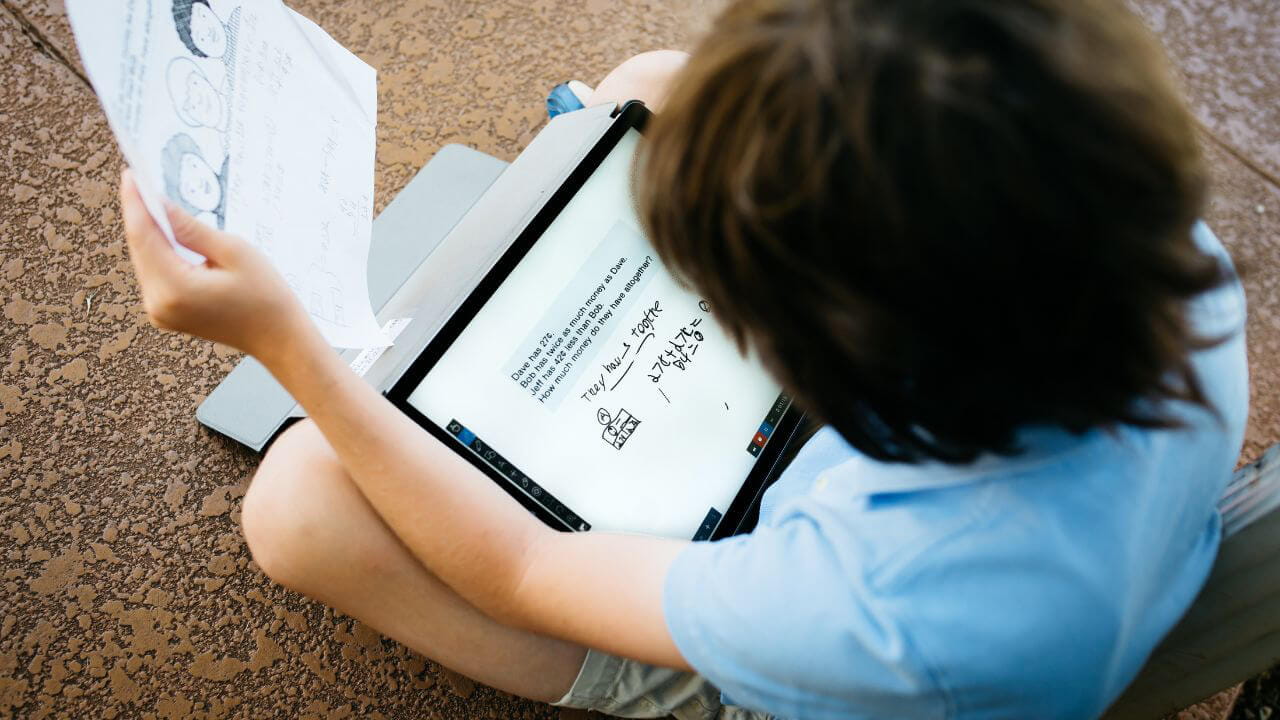
They told us that predictability reduces their anxiety. Visual schedules, whether on a SMART Board or their own device, helped them feel oriented and safe in their day. They told us that individual whiteboards, digital or physical, gave them room to think without the pressure of performing. To rehearse an idea, to sketch out an answer, to communicate through drawing when speaking out loud felt like too much. They told us that being asked what worked for them, was itself a kind of relief.
One of the most consistent themes across our data was the difference between environments where autistic students were accommodated and environments where they were genuinely included.
Accommodation says: here's a workaround for your differences.
Inclusion says: your uniqueness is welcomed here.
UDL is one of the most powerful frameworks. It's not about creating special tracks for special students, it's about building flexible learning environments where every student has multiple ways to engage, to represent their understanding, and to take action.
And the good news is that for a student, even one small change can be the difference.
For educators, that might mean trying one new UDL strategy this month — using a visual schedule to open the day, offering individual whiteboards during whole-class activities, or simply asking your autistic students what's working for them. The 36 recommendations from our research with SMART are freely available, and each one maps to practical, classroom-ready action.
For school leaders, it might mean investing in professional development that goes beyond "autism awareness" to build real educator capacity — not just to recognise neurodivergence, but to respond to it with both skill and curiosity.
For all of us, it means sitting with the discomfort of recognising that many of our systems, structures, and technologies were designed with a very particular kind of learner in mind. And asking what it would take to genuinely design for everyone.
Autistic learners are complex, creative, extraordinary people who have been asked to do an enormous amount of quiet, exhausting work to fit into environments that don't fit them. This April, I'd love for us to redirect some of that effort — and start asking what we can do differently, so they don't have to.
Everyone has the right to be safe, happy, and learning in their classroom. We have the tools, the evidence, and now, increasingly, the voices to make that possible.
Explore the full findings from the SMART Technologies and University of Melbourne research partnership — including all 36 recommendations for supporting neurodivergent learners with digital technology — here: